Understanding Sensor Size: Full Frame vs APS-C
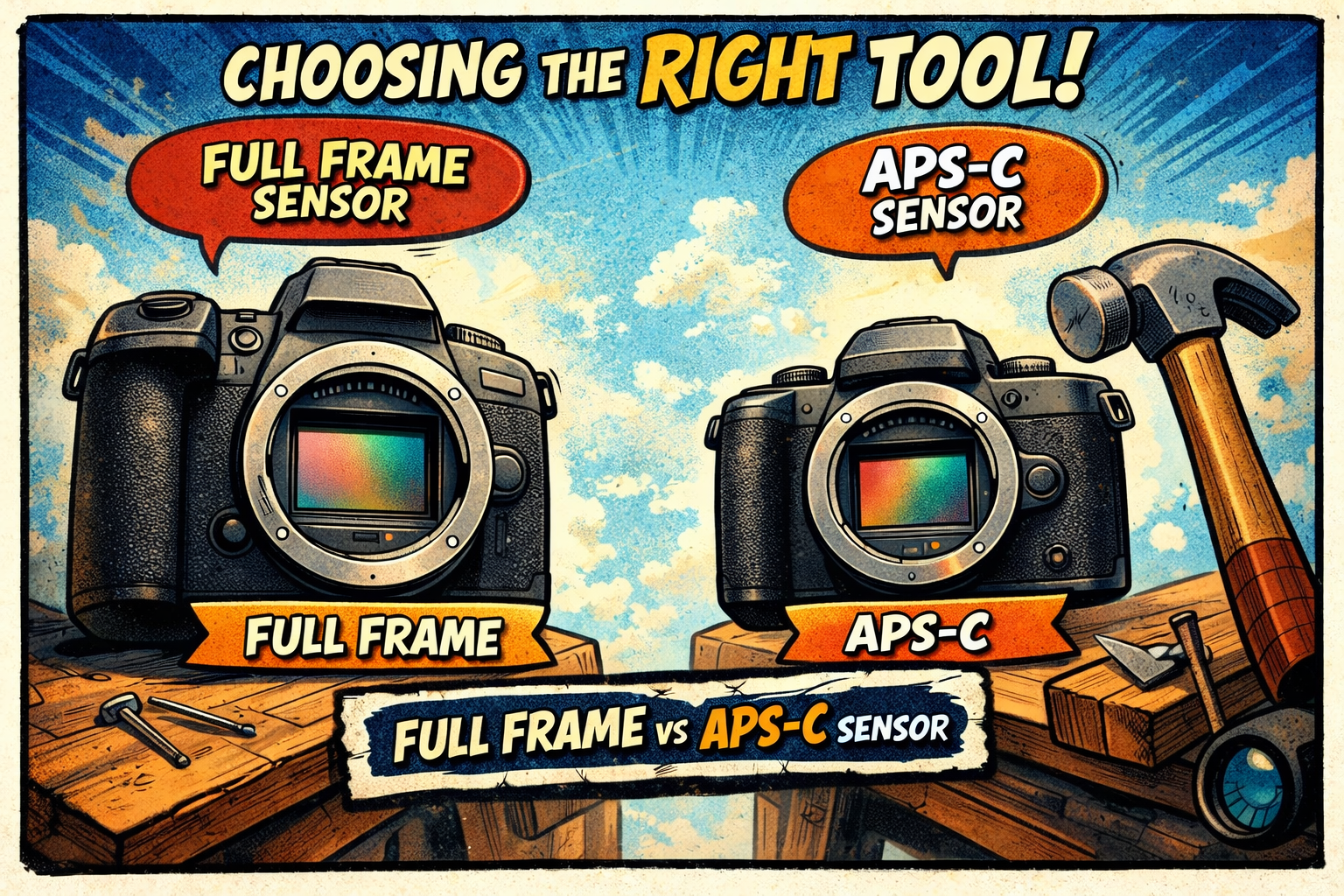
If you’ve started researching cameras at all, you’ve probably seen terms like Full Frame and APS-C thrown around—often without much explanation. These refer to a camera’s sensor size, and it’s one of the most commonly misunderstood concepts in photography.
Part of the confusion comes from how people talk about it. Sensor size is often treated like a ranking system instead of a tool choice. Some photographers even think of full frame as a destination—or a graduation prize. In reality, it’s nothing like that.
Sensor size isn’t about leveling up. It’s about choosing the right tool for the kind of photography you want to do.
Start With the Tool, Not the Spec Sheet
If you’re working on a woodworking project, you don’t ask which hammer is the best—you ask which hammer is right for the job. No one “graduates” to a sledgehammer, either. It’s just a different tool designed for a specific purpose.
Camera sensors work the same way.
Full frame and APS-C sensors are simply different tools. One is not inherently better than the other, despite what you might read in online forums. Both are used by hobbyists, enthusiasts, and professionals alike—often interchangeably.
Great photographs come from your intent as a photographer, not the camera itself. Fantastic images are made every day with both sensor sizes. These are the same concepts I explore hands-on in my Intro to Photography workshops: the camera supports the work, it doesn’t define it.
What Sensor Size Actually Changes (Without Getting Technical)
Sensor size affects how a camera behaves, not the person holding it. Here are the practical differences that actually matter.
Field of View
A full-frame sensor shows a wider view of the scene. An APS-C sensor applies a slight “crop,” which makes it feel like you’re a bit closer to your subject when using the same lens.
Neither is better—just different. That extra reach can be helpful in some situations, while the wider view of full frame can be useful in others.
Depth of Field
Full frame makes it easier to achieve a very shallow depth of field—where the background melts away behind your subject.
APS-C, on the other hand, keeps more of the scene in focus by default. Depending on what you’re photographing, this can actually be an advantage, especially when you’re learning composition and focus.
Low-Light Behavior
Generally speaking, full-frame cameras handle low-light situations a bit more comfortably.
That said, modern APS-C cameras are extremely capable. As a beginner, you’re unlikely to notice a meaningful difference in real-world shooting. Technique, lens choice, and understanding light matter far more than sensor size here.
Why APS-C Is Often a Feature, Not a Compromise
APS-C sensors are smaller than full frame, but that comes with some real benefits—many of which are often overlooked.
Smaller sensors allow for lighter, more compact camera systems, which makes them easier to carry and easier to use consistently. Lenses designed for APS-C cameras are typically:
Smaller
Less expensive
Still optically excellent and built with the same care
That slight crop factor can also be a benefit for certain types of photography, including:
Wildlife
Sports
Travel
Street photography
One important lens note: you can use full-frame lenses on an APS-C camera, but you generally should not use lenses designed specifically for APS-C cameras on a full-frame body. It’s an easy rule to remember and avoids confusion later on.
Many photographers actively choose APS-C systems—not because they’re limited, but because they suit the way they like to work.
Choosing the Right Hammer for Your Photography
Your camera is a tool, and that tool should support how—and what—you want to shoot right now.
As a beginner, what you’re really developing isn’t your sensor—it’s your eye. You’re learning how to see light, how to compose a frame, and how to move your feet to make a stronger photograph.
Both APS-C and full-frame cameras are fully capable of producing beautiful, professional-quality results. Neither one will make you better, and neither one will hold you back.
Whichever you choose, focus on the fundamentals: learn to see first, move your feet, and work with the light you have.
The best camera is the one that helps you show up, pay attention, and make the photograph you intended to make.
This article is part of my Beginner Photographer’s Buying Guide series.
Already bought your camera? Here’s a guide to what comes next.